
Introduction
With the ever increasing amount of information on the web, users are loaded with information. They face the challenge of finding the most relevant and useful information on the internet. Recommendation systems have emerged as one of the solution to this problem of huge data flood.
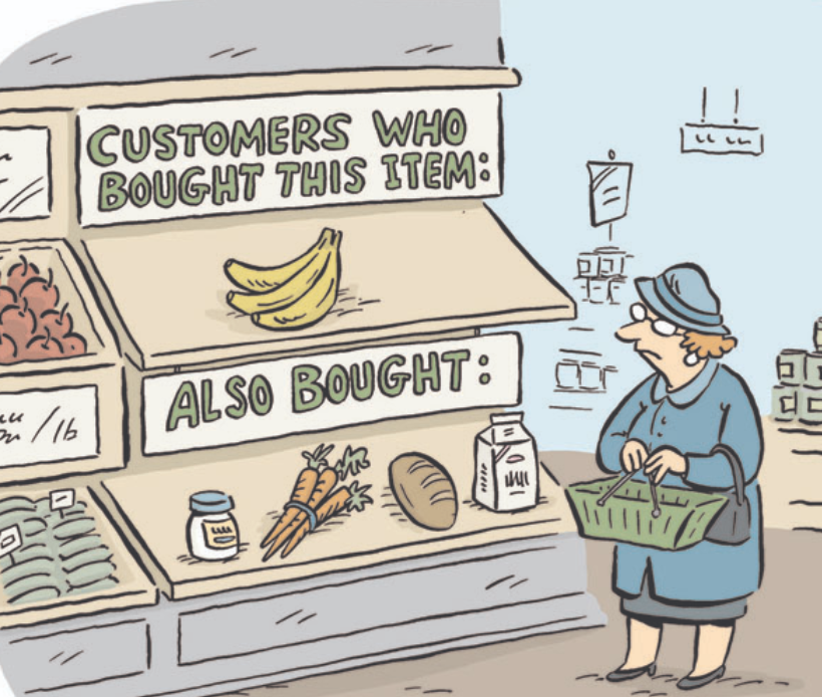
In general, recommendation systems rely on user modeling approaches to approximate user preferences and build user profiles based on users’ purchase history, item ratings etc. Collaborative Filtering and Content Based Recommendation are the standard techniques of recommendation used in the industry. However, standard recommendation systems suffer from many problems:
- Cold Start Problem - when a new user starts using the system
- First Rater Problem - when a new item is introduced
Cross Domain Recommender Systems are one of the newer techniques used to alleviate cold-start problem. The main idea is to use rating information accumulated in one domain (source domain) to improve the quality of recommendations in another domain (target domain).
Dataset
For the purpose of this project, we used two datasets:
- MovieLens-100k
- Yelp Challenge Dataset
MovieLens-100k
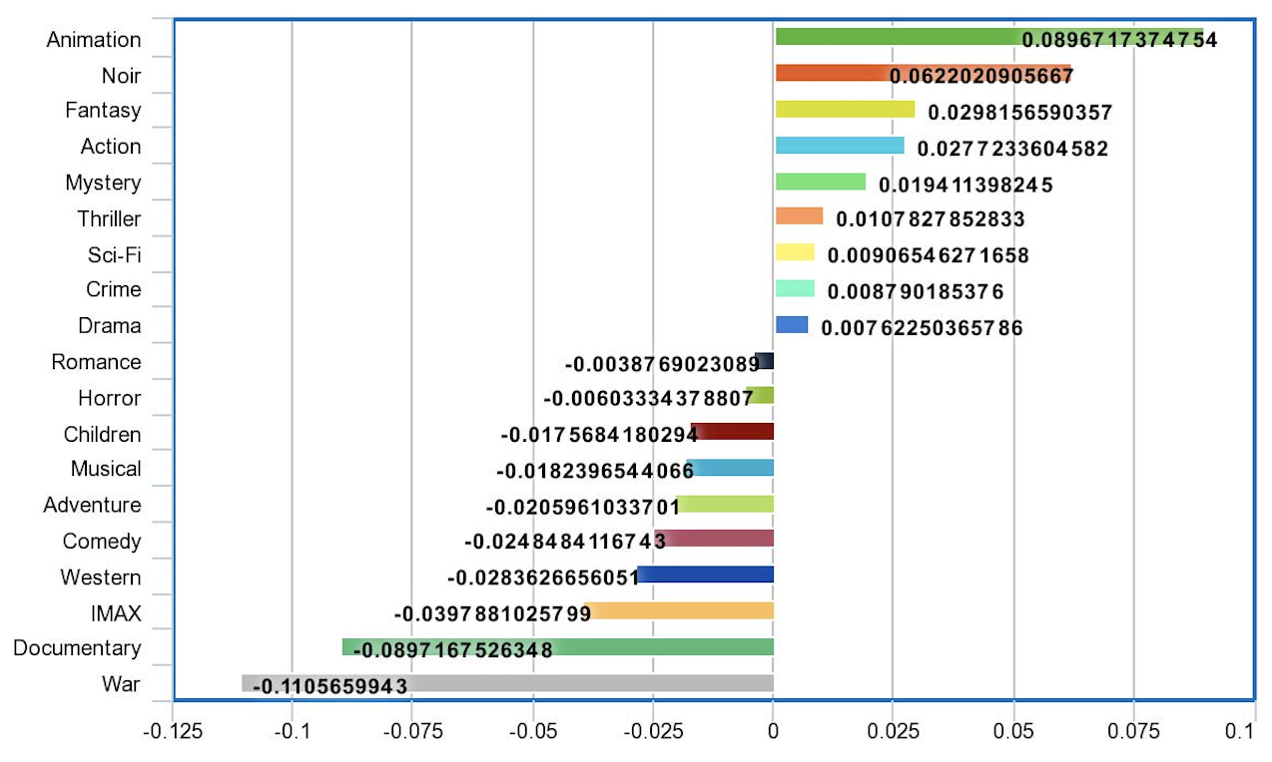
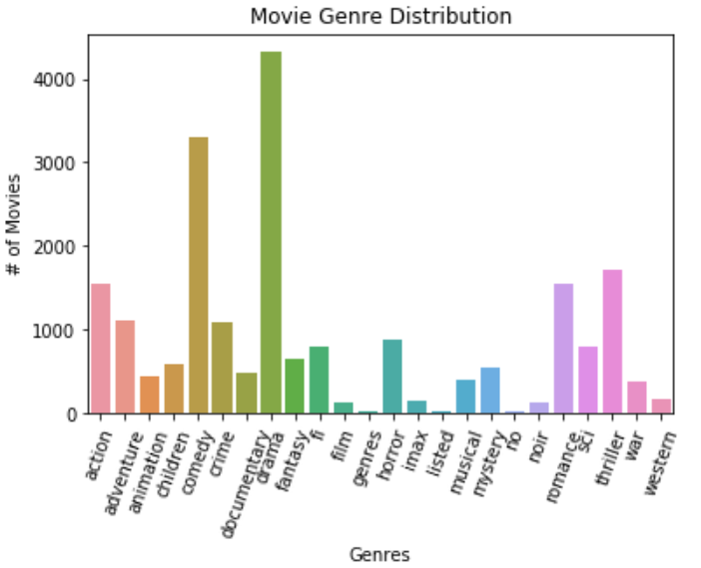
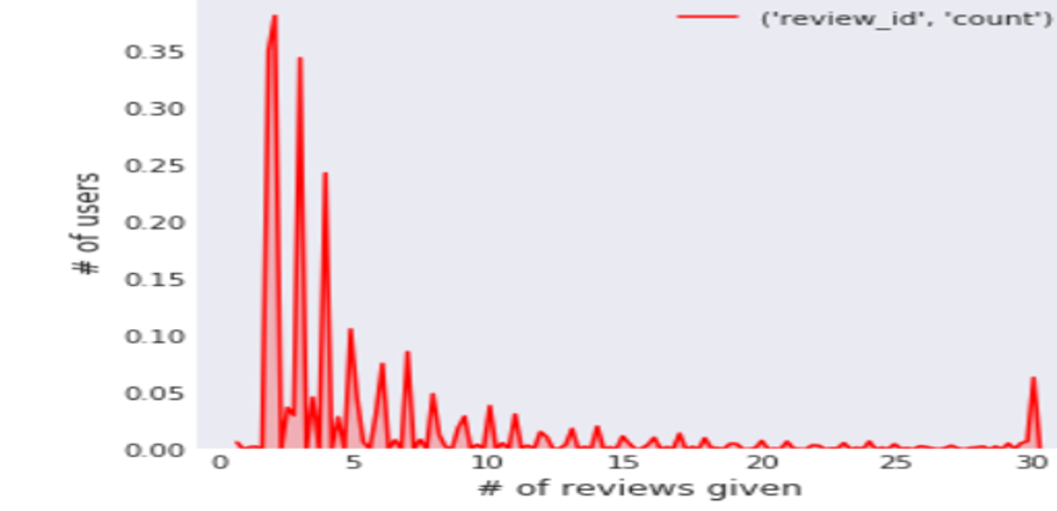
First, we performed some data exploration on the movie lens dataset. Here are the plots:
Yelp
Related Work
Literature Survey of cross domain recommender systems:
Cross Domain Collaborative Filtering
Collaborative Filtering boils down to analyzing the user-item matrix. It can be easily extended with other auxiliary domains under the pretext of common users or common items. 1,2,3
Content Based Cross Domain Recommendations
Content based CDR models users and items as feature vectors and recommends based on similarity between the two. If users/items are common among different domains the feature vectors can simply be concatenated to incorporate more information. 4
Neural Network based CDRs
- Multi-View Deep Neural Network -
Content based techniques calculates features to represent users and items. Neural networks are powerful feature extractors and can be effectively used in a multi/cross domain setting. 5,6 - CCCFNet (Content Boosted Collaborative Filtering)
Content-based modelling of MV-DNN is used to augement the Collaborative Filtering matrix. The idea is to the correlate the latent-factor matrix of the CF part with the content-modelling of MV-DNN. 7
In all the above explained methods either there is single or mutiple cross domains. However, there is very little analysis on which domains can help the prediction in the target domain the most. A gap that we seek to fill.
Proposed Solution
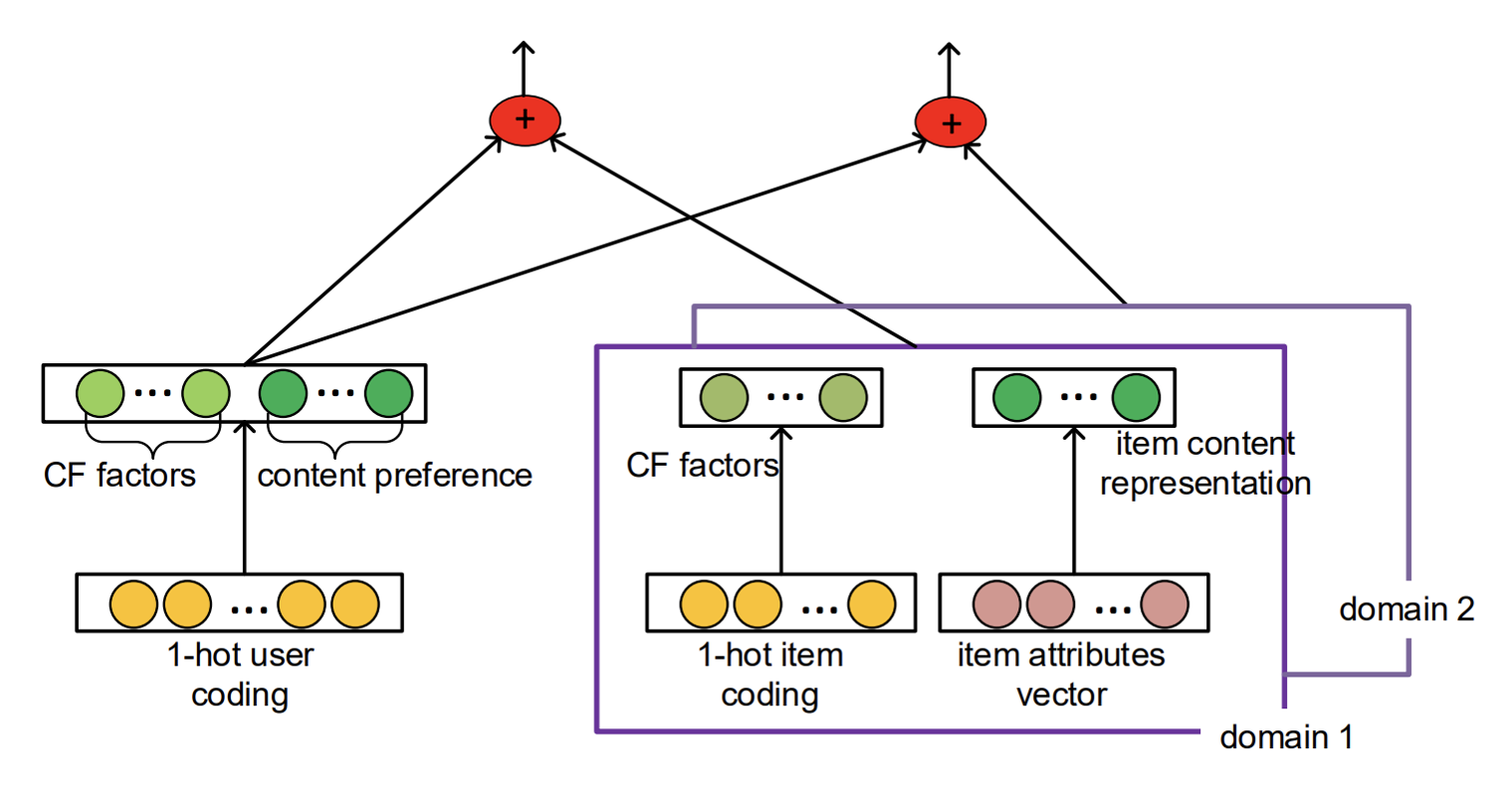
- CCCFNet model- Unified Content-based and Collaborative Filtering
- The content information is used to augment the CF matrix
- The proposed methodology performs better as compared to other recommendations techniques like SVD and Bayesian Matrix Factorization
- The loss function for the CCCFNet model is given by:
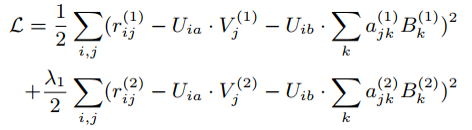
Where,
Uia - User’s Collaborative part
Uib - User’s Content preference part
Vj - Item’s Collaborative part
Results
We test a bunch of simple baselines such as SVD, Biased-Matrix Factorisation and CCCFNet.
- MovieLens Dataset:-
For CCCFNet, to simulate 2 independent domains we split the utility matrix of movieLens dataset. The performance of the different methods is compared based on the RMSE values. CCCFNet always beats the simpler baseline methods and hence establishes that it is a better technique by the virtue of using a hybrid Content and CF method.
- Yelp Dataset:-
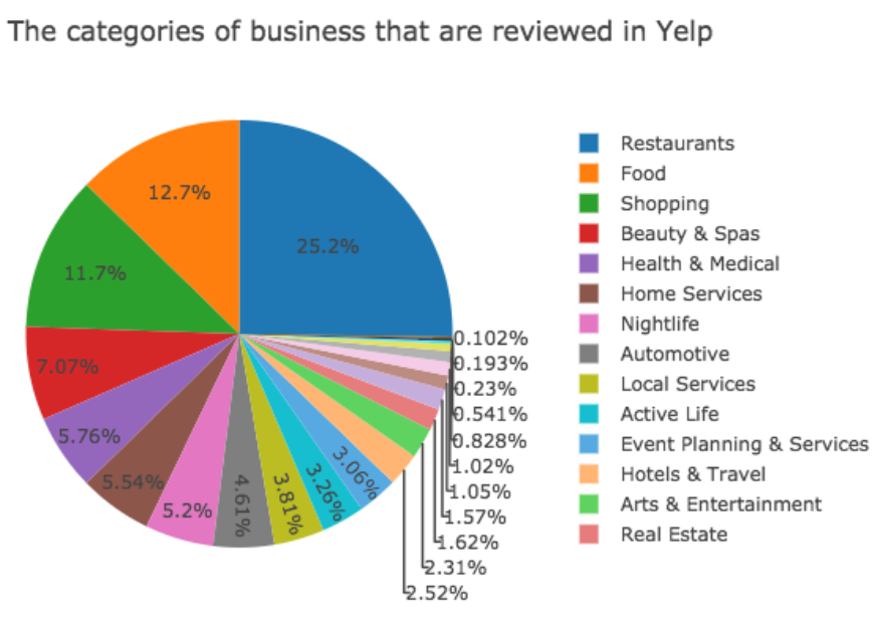
We evaluated 2 different source domains for one target domain.
- Domain Pair 1
- Source Domain - Food
- Target Domain - Restaurant
- Domain Pair 2
- Source Domain - Shopping
- Target Domain - Restaurant
The idea was to see if there is a appreciable increase the recommendation performance in one of the configurations. Ideally, the food-restaurant recommendation should perform better than shopping-restaurant since the domains are correlated.
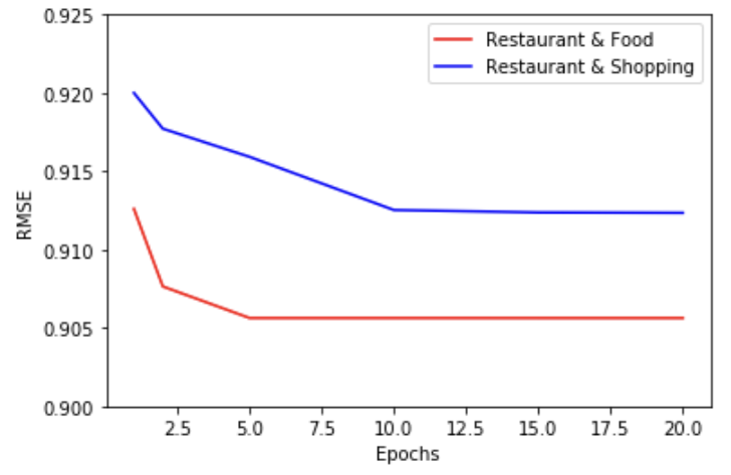
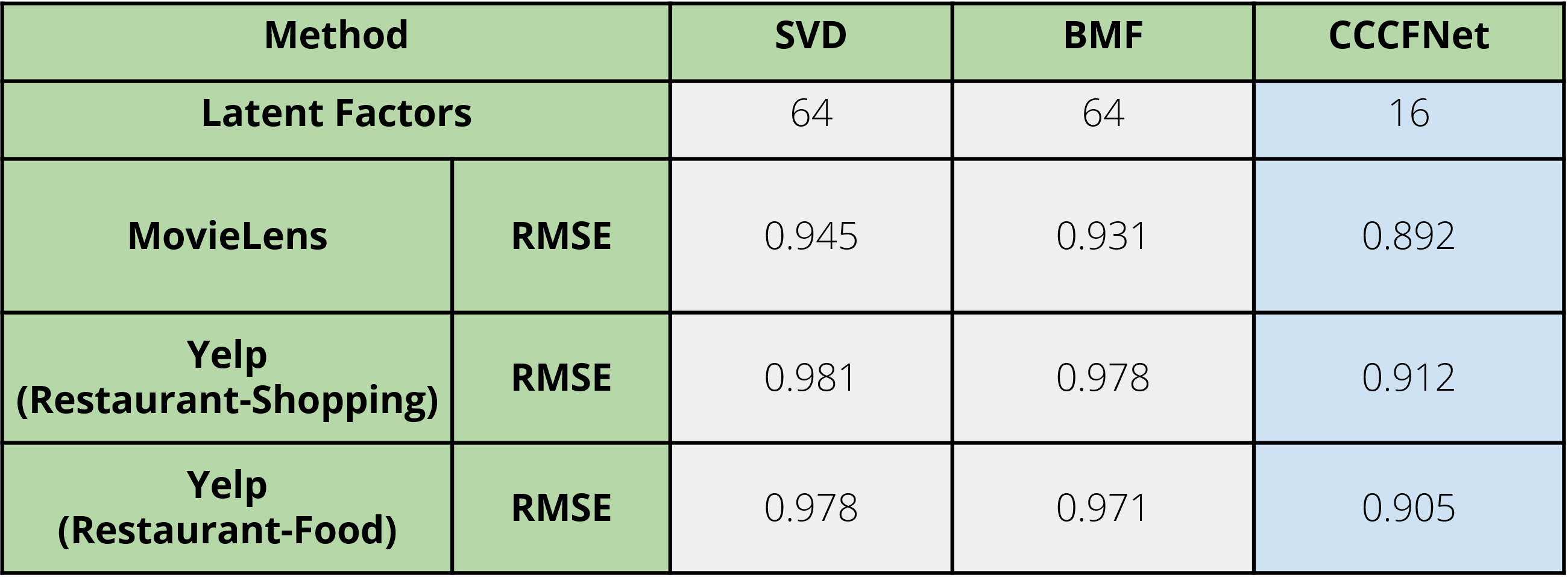
We measure the recommendation performance using the RMSE.
Discussion
- Using combination of source and target domain for providing recommendations improves RMSE
- Choice of auxiliary domain remains tough
- Feeding model with more data; decreasing the sparsity level gives better results
Ethical Consideration
- Assumption that interest in one domain will always map to another domain is misplaced
- Eg. Teenage kid interested in shooting games like Call of Duty might recommend violent videos

References
- B. Li, Q. Yang, and X. Xue, “Can movies and books collaborate? cross-domain collaborative filtering for sparsity reduction,” in IJCAI, 2009, pp. 2052-2057. ”Transfer learning for collaborative filtering via a rating-matrix generative model,” in ICML, 2009, pp. 617-624.
- Lian, Jianxun, et al. “CCCFNet: a content-boosted collaborative filtering neural network for cross domain recommender systems.” Proceedings of the 26th International Conference on World Wide Web Companion. International World Wide Web Conferences Steering Committee, 2017.